My current Top 5

My current Top 5
Showing posts with label Best Picture Ranking. Show all posts

6/20/2011

Here they are once again...


So, all the movies have been ranked. Once again, here they are:

83. Cavalcade
82. Cimarron
81. Rain Man
80. Going my Way
79. The Broadway Melody
78. The Greatest Show on Earth
77. Terms of Endearment
76. Forrest Gump
75. Grand Hotel
74. Gladiator
73. Rocky
72. A Beautiful Mind
71. Chariots of Fire
70. Crash
69. Braveheart
68. Patton
67. The Sound of Music
66. Around the World in 80 Days
65. Kramer vs. Kramer
64. Marty
63. Mrs. Miniver
62. Gentleman's Agreement
61. The Sting
60. Driving Miss Daisy
59. The Great Ziegfeld
58. Tom Jones
57. An American in Paris
56. A Man for all Seasons
55. The Lost Weekend
54. The French Connection
53. Ben-Hur
52. The Life of Emile Zola
51. Gigi
50. Out of Africa
49. You Can't Take it With You
48. Slumdog Millionaire
47. Wings
46. In the Heat of the Night
45. Dances with Wolves
44. The Departed
43. Mutiny on the Bounty
42. The King's Speech
41. Titanic
40. How Green was my Valley
39. Oliver!
38. Ordinary People
37. Platoon
36. Hamlet
35. All the King's Men
34. My Fair Lady
33. No Country for Old Men
32. Million Dollar Baby
31. From Here to Eternity
30. The Deer Hunter
29. The Best Years of our Lives
28. Chicago
27. The Last Emperor
26. All about Eve
25. Gandhi
24. On the Waterfront
23. The Hurt Locker
22. It happened one Night
21. West Side Story
20. The Silence of the Lambs
19. One flew over the Cuckoo's Nest
18. Shakespeare in Love
17. The Apartment
16. Unforgiven
15. The Bridge on the River Kwai
14. Midnight Cowboy
13. Annie Hall
12. Rebecca
11. Amadeus
10. American Beauty
09. Casablanca
08. Schindler's List
07. The Lord of the Rings: The Return of the King
06. Lawrence of Arabia
05. The Godfather: Part II
04. Gone with the Wind
03. All Quiet on the Western Front
02. The Godfather
01. The English Patient


And that's it!


Well, that was it. 

To be honest, I was very hesistant at first to do this ranking because I knew how controversial my number 1 would be. But, after all, it's my blog and if you disagree with my ranking I hope that I have encouraged you to publish one yourself! 

I hope you all had fun following my ranking. I know that it took me a lot of time but I am very busy at the moment so I didn't have much time to do it. I hope I will be a little faster from now on.

Of course, I want to thank all you guys for commenting on my ranking - without you, it would only have been half as much fun!!!

Number 01: The English Patient (Best Picture Ranking)

Don’t rub your eyes, you’re seeing right: The English Patient is my number 1. And I am very well aware how unpopular this choices is. It’s the only winner in this category that has a whole sitcom-episode dedicated to the hate towards it. Complains come from all directions – it shouldn’t have won over Fargo, it’s boring, long, sleep-causing etc…Well, what can I say? For me, it’s simply the most perfect movie in this ranking that is also able to touch me more deeply than any other winner in this category. Unlike The Apartment or Annie Hall, I also didn’t need time to develop this love – even when I was still young I already admired this movie more than anyone I had ever seen. From the first moment Márta Sebestyén’s beautiful voice fills the screen and slowly changes into what I consider the best soundtrack of all time, I am overwhelmed, lost, captured in the world created by Anthony Minghella.

I don’t want to use this review to defend my opinion since I know that I will not convince anyone anyhow so I just want to stand up and declare: My name is Fritz and I love The English Patient. Boy, that felt good! I think that it’s very hard to explain why a certain movie is your favorite. I mean, I can praise the performances, the technical values, the script and the direction but it’s more than all these components that make it my number 1. Somehow, this movie is able to connect with me on a level the others couldn’t. The last 30 minutes have me in tears basically non-stop but The English Patient is a movie that doesn’t only make me cry by the tragic of the story but also simply by its beauty, its perfection and its overwhelming magnificence.

The performances here are all top-notch. Ralph Fiennes is an unlikely romantic hero and his character is an even more unlikely romantic hero but it works because The English Patient isn’t about a teenage romance but about an adulterous affair between two grown-up people who are very well aware of their doings and who cannot seem to explain their attraction to each other any more than Minghella can. The English Patient doesn’t give any reason for the affair and while most others tend to criticize it for this, I don’t really need an explanation – there is an obvious attraction between these two characters but why they fall in love will be their secret forever. Kristin Scott-Thomas is perfect as a woman who seems to be both out of ice and out fire. Juliette Binoche is outstanding as the caring nurse while Willem Defoe, Naveen Andrews and Colin Firth provide wonderful support.

As you see, I love the cast but I would never call it the best ensemble ever – so the cast alone can’t explain the number 1. There is also the story they play – the complex love affair, a story of betrayal and friendship, of war and peace. All characters seem to be lost while looking for something or someone to help them. Maybe I love this movie so much because I get so easily involved into the misery of tragic characters…who knows. I already said that Yared’s score is my favorite of all time but I think it deserves a second mention. His compositions are so peaceful but also so powerful and perfectly accompany the structure of the story. The cinematography…well, who could forget these images? Two flying planes, Juliette Binoche looking at the pictures in the church, the apparently never-ending desert. No other movie in this line-up is able to win me over with its beauty in the same way as The English Patient.

But it’s not just the beauty of it. I don’t want to be that shallow when I pick my number 1. It’s also what is hidden inside – as I said, the tragedy of the story, the fate of all the characters, involves me so much that I can forget everything else. The English Patient is probably not a perfect film from most point-of-views but it is from mine. Even more than perfect. Like the performances of Emily Watson in Breaking the Waves or Meryl Streep in Sophie’s Choice, The English Patient leaves me almost feeling empty because every emotion inside of me seems to have been used up during the run of the movie. If a movie has a power to touch me so strongly while also being such a complex and deep drama with so much beauty to cherish and so much poetry to discover, then this is my number 1.

I don’t think that anymore words are necessary here – it’s not possible for me to put my feelings about this movie into words anyway. I just hope you are able to accept this as my number 1.

Number 02: The Godfather (Best Picture Ranking)

By now, it’s almost a cliché to call The Godfather one of the greatest movies of all time, but if the shoe fits…

The Godfather, or course, tells the story of the Corleone family and their involvement in the world of organized crime. It’s the kind of movie that everyone seems to know even if they haven’t seen it yet. Marlon Brando’s legendary performance, the head in the bed or the final shot have all become part of cinema history by now. And why not? The Godfather is just as good as it reputations claims it to be – and even better. It’s a wonderful example for perfect storytelling, character development, for the right balance between tension and peace.

The cast of The Godfather surely plays an important part in the movie’s greatness. Marlon Brando won an Oscar for his ultimate portrayal of the Don – it’s maybe not his greatest performance as an actor but it’s hard to deny the powerful impact he leaves on this movie. Al Pacino is the real leading character of the story as Michael, the young man who slowly gets drawn into the family – it’s an outstanding performance that doesn’t need to hide itself behind his works two years later. Robert Duvall gives the right amount of quietness to his part while James Caan burns up the screen as the hot-headed of the brothers. Talia Shire gets some impressive moments as the sister and Diane Keaton beautifully shows the innocence of her character.

What makes The Godfather such a masterpiece is the outstanding combination of actors, screenplay, direction and, of course, the score which results in a movie that somehow seems like a cliché about the mafia as we expect it but at the same time goes much deeper and constantly redefines our expectations.

The Godfather moves along with the right tempo, combining quiet but very tense moments like the opening scene with shots of violence or domestic abuse in the most effective way. It’s not only a typical gangster movie but instead presents very realistic and believable characters that are allowed to develop and present themselves constantly in a different light. The Godfather actually involves the viewer into the life, the dreams, the hopes and the plans of these characters.

I think I don't need to say anymore since I am sure everybody can perfectly understand my appreciation for this masterpiece.

Number 03: All Quiet on the Western Front (Best Picture Ranking)

When I started this ranking, I had little doubt that Gone with the Wind would be my number 1 movie from the 30s. But one of the last movies I saw was All Quiet on the Western Front and suddenly Gone with the Wind dropped to number 2. Personally, I was not expecting to be blown away like this by this anti-war movie from the early 30s but I was!

It seems almost strange to watch an anti-war movie that was made before World War II but I think the fact that this movie was made before the Nazis came to power helped to make this a very balanced movie that treats its German characters with the same respect that American characters would receive since after World War II, even movies about World War I seem to turn Germany into Nazi-land: The prequel.

Of course, the question is: could it be that I only appreciate this movie this much because of the German characters and the German point-of-view? But I strongly doubt it because I never even thought about nationality while watching this movie which is probably the biggest compliment I can give it at the same time – it’s a story that isn’t about nations, it’s about the horror of war and how propaganda turns even the most intelligent men into blind servants of death. Yes, All Quiet on the Western Front cannot hide its age but considering that only two years prior the Academy honored movies like The Broadway Melody or Coquette, makes this movie only even more impressive.

It’s hard to describe what it is about All Quiet on the Western Front that made it reach number 3 in my ranking. I think it’s the simple fact that no other anti-war movie has ever shattered me as much as this one. I think the reason for this is the way that the central characters are presented – how they are blinded at school by their fanatic teacher who bullies them into fighting for their country and learn at the first day at the front that reality is very different. It’s their fight for something to eat, their fear of death, their naivety compared to the experience of the men who are already at the front that really creates the strength of the movie. The sequence that shows a pair of boots that go from one killed soldier to the next is especially unforgettable. It’s the desperation that dominates the lives of these kids that turns All Quiet on the Western Front into one of the most haunting movies in history – the image of Paul, the central character of the story, praying besides the deathbed of his friend Kemmerich, telling God that Kemmerich doesn’t want to die is absolutely heartbreaking.

The battle sequences of this movie are also first-class in their technical execution and devastating in their message. The fight scenes at the graveyard are horrifying but even more so is the scene of Paul being trapped together with a French soldier whom he has mortally wounded. The soldiers is slowly dying next to Paul who is almost going insane with guilt and grief. But the movie also captures some quiet moments that are just as powerful – when Paul meets a French girl and goes to her home with her, we don’t need to see some sex scene as we would probably today; the shot of some shadows and the voices of Paul and the girl are enough and create a scene that is much more memorable than anything more ‘obvious’ could have been.

All Quiet on the Western Front is as powerful as a movie can be and it does not only focus on the horror of the war at the front but also the horror of the war at home – when Paul comes home and sees his old teacher trying to convince other boys to go to war it becomes clear to him and the viewers that there will be no end to this senseless killing. The final image of the movie shows the mass graves where Europe’s countries bury their future. 

All Quiet on the Western Front seems to be both a classic but also a rather forgotten movie but I happily discovered it as one of the most powerful statements against war ever made.

Number 04: Gone with the Wind (Best Picture Ranking)

Well…what can there be said? Probably not only the most famous movie to ever win the Oscar for Best Picture but quite simply the most famous movie of all time, Gone with the Wind is considered the ultimate Hollywood masterpiece, the crowning achievement of what is considered to be the ‘Golden year of American cinema’, 1939. And you know what – it’s true.

A movie with such a high reputation as Gone with the Wind should normally not be able to live up to it, but Gone with the Wind miraculously does. It could be easily dismissed as a long soap-opera or as an expensive ‘woman-picture’ but it’s quite simply one of the most amazing epics that ever hit the screen while also being a surprising character-study about the will to survive and to get ahead.

First of all, what about all the criticism that Gone with the Wind receives? A point that is often mentioned is its presentation of black characters. Well, personally, I think that Gone with the Wind presents its black characters just as what they are during the time the movie is set – slaves. I don’t expect these characters to be highly intelligent or the center of attention since they are slaves and surely never had an education. The character or Prissy might be offensive to someone but I don’t truly see her as a symbol for every black character back then but instead rather as one single character who simply happened to be like this. And even if you’re upset about Prissy, then there is still the character of Mammy who is much more developed than you would expect and Hattie McDaniel’s wonderful portrayal turns her into one of the most memorable characters of the movie. Another often negatively mentioned point against Gone with the Wind is its too romantic presentation of the South in general – well, I am not an expert in American history so I guess that some things are true and some are exaggerated but, after all, this is a movie from a Southern point-of-view. And during Gone with the Wind, I never have the feeling that the movie is trying to tell its audience that everything used to be better back then and that the South is something noble to die for – instead, it seems more like a general portrayal of characters who have to accept the change around them, who go from rich to poor and have to learn how to fight to survive.

So, now to the good. Where can one start? Well, I guess the only place to start is Vivien Leigh. The sheer fact that the producers back then actually searched so long for the right actress and then decided that an unknown British actress would be the best choice to play the Southern belle Scarlett O’Hara is probably one of the luckiest incidents in movie history as it gave way to the greatest match of actress and character in movie history. If ever anyone was truly born to play a role, it was Vivien Leigh as Scarlett. End of story. No more words necessary.

But even though  Vivien Leigh carries this epic on her shoulders, Gone with the Wind gives much more actors the chance to shine. Clark Gable couldn’t be more perfect as Rhett Buttler while Olivia de Havilland gives much more complexity to her saintly Melanie than immediately noticeable. Leslie Howard is often considered the weak link of the cast and while it can be agreed that it’s hard to believe that Vivien Leigh would lust for this guy, he still gives a very competent and satisfying performance.

All the technical values of Gone with the Wind are perfect, too, and it’s a shame that there hadn’t been an Oscar for Costume Design yet because Scarlett’s gowns alone would have been worth the prize. It’s no surprise that Gone with the Wind so completely swept the awards that year.

Gone with the Wind combines so much that it remains fascinating from minute 1 to minute 200. It’s a love story, a story of greed and selflessness, of growing up and starting anew. From the first moment that Max Steiner’s legendary score opens the movie you know that you are watching Hollywood magic. So many scenes stand out – Scarlett dancing in her black dress, the escape from Atlanta, ‘As God is my witness’, ‘Frankly, my dear’ and so much more…my personal favorite is probably the scene when war is declared and everyone at Twelve Oaks is running down the stairs – only Scarlett is walking up, not caring about politics, alone in her thoughts.

Well, I want to keep my review short for now and I guess that it is not really necessary to say anything more about a movies as famous as this one.

Number 05: The Godfather: Part II (Best Picture Ranking)

The eternal question among movie fans seems to be: The Godfather or The Godfather Part II? As you can see, my answer would be The Godfather but considering that the sequel is also in my Top 5 in this ranking, both movies can consider themselves to be among the greatest ever (at least in my opinion).

The brilliance of The Godfather Part II lies in its mixture of two major storylines – one of Michael Corleone and his actions as head of ‘the family’ and a flashback that tells how his father, Vito Corleone, came to New York and founded the Corleone crime family. Each story itself does not reach the same level of excellence that the plot of The Godfather reached but every time one of the story is in danger of losing some of its brilliance, The Godfather Part II changes its focus to the other story and captivates the viewer once again.

Personally, I prefer the plot concerning Michael Corleone a little bit more since it is an amazing display of the power of money and corruption, of questions regarding morality, loyalty, love and friendship and because Al Pacino gives a stunning performances for the ages that is completely deserving of its legendary status. But, of course, the cast around him does incredible work, too. Diane Keaton gives an unforgettable supporting performance and her confrontation scene with Al Pacino regarding her pregnancy is maybe the finest moment of the whole movie. Talia Shire got an Oscar nomination for her small role as Michael’s sister and while it can be argued if she was really worth that nomination, her plea for Michael’s brother Fredo is a very moving and honest moment. Speaking of Fredo, John Cazale is the unsung hero of this piece and his characterization is pitch-perfect and his scene with Al Pacino in Cuba, when Michael tells him that he broke his heart, is another highlight in a movie full of them.

In the flashback-story regarding Vito Corleone, Robert De Niro won himself an Oscar and he certainly captured the spirit that Marlon Brando had created two years earlier perfectly. It’s thrilling to see how the man who would later be Don Corleone lived before those times, how he came to New York as a little boy, how he started a family and later joined the world of crime.

I don’t think it’s really necessary to write anymore – surely everybody knows this movie and its reputation so it should be no surprise that I put it on number 5 in my ranking.

Number 06: Lawrence of Arabia (Best Picture Ranking)

Almost at the beginning of Lawrence of Arabia, one character tells T.E. Lawrence, the title character of the story, that only Bedouins and Gods can enjoy the desert – at the end of the movie, T.E. Lawrence will feel like both.

Lawrence of Arabia is the second Oscar-winner in David Lean’s filmography and it even tops his already brilliant The Bridge on the River Kwai. It’s a masterful story of a man who becomes involved in World War I in Arabia and later becomes obsessed with his own doings and surroundings. Just as you would expect from a movie by David Lean, Lawrence of Arabia is such a visual masterpiece that it puts almost all other epics to shame. It’s almost impossible to understand how he can find so many breathtakingly beautiful shots of the desert – but he can. Supported by one of the most majestic scores in motion picture history, the camera in Lawrence of Arabia catches so many little miracles that even two viewings don’t seem enough to find them all.

In the title role, Peter O’Toole gives one of the most mesmerizing performance ever caught on the screen. He is flamboyant, he is down-to-earth, he is arrogant, he is humble, he carries this massive epic on his shoulders and does so without any flaw. All the male supporting players (are there even any women in this movie?) does wonderful work, too, from Omar Sharif to Anthony Quinn to Alec Guiness and Arthur Kennedy and everyone else.

And also like most other David Lean movies, Lawrence of Arabia takes its time (actually, a lot of time) to develop itself and tell the main story – but it’s told so magnificently that it could have even taken a few more hours and I wouldn’t have minded. From T.E. Lawrence’s first arrival in the desert to the trip to Aqaba during which Lawrence returns to find a lost man only to have fate turn its back on him some time later in a truly chilling scene and right up to the final moments of the story, David Lean shows his talent as a storyteller of highest quality.

The attack on Aqaba itself it shot absolutely thrillingly and the following scenes of Lawrence trying to reach the Suez Canal and later losing control over himself, becoming more and more obsessed which his own image hold the viewers’ attention the whole time.

At some point Lawrence asks 'Do you think I'm just anybody?`- the same way Lawrence of Arabia could ask 'Do you think I'm just any movie?' and the answer would be a big 'No, you're truly one of a kind!'

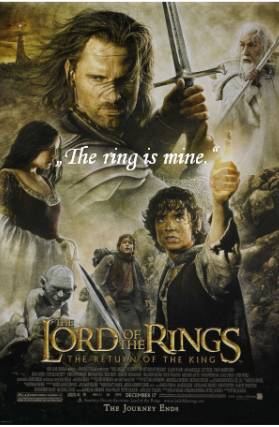
Number 07: The Lord of the Rings: The Return of the King (Best Picture Ranking)

I have to be honest and say: I don’t care about fantasy movies. Never have. Nor do I care about fantasy books. I tried to read The Lord of the Rings three times already but somehow I can never bring myself to go on because I just don’t care…but somehow Peter Jackson completely won me over with his movie version of Tolkien’s trilogy about Hobbits, Orks and the One Ring. It seems almost impossible to separate the three movies from another and maybe the high ranking for the final installment is a testament to the whole series but I honestly only tried to think of The Return of the King and not the two predecessors while I determined the position in this ranking. And since I personally think that the third of the three movies is also the best, this position seems justly earned.

I think that, of all the Best Picture winners, The Lord of the Rings: The Return of the King contains my single most favorite scene.
‘Arise! Arise, Riders of Theoden! Spears shall be shaken, shields shall be splintered! A sword day... a red day... and the sun rises! Ride now!... Ride now!... Ride! Ride to ruin and the world's ending! Death! Death! Death!’
This is a scene that, no matter how many times I watch it, constantly takes my breath away. It’s a pitch-perfect combination of plot, cinematography, editing and score. Maybe it’s because I am always overwhelmed by scenes in which new fighters join a battle to help the loosing side but I simply consider this one of the greatest moments in movie history.

But besides this scene, The Return of the King has much more to offer. It has brought a new meaning to the word ‘spectacle’ and the fact that Peter Jackson was able to bring this gigantic tale to the screen without any visible compromise is surely a stunning achievement. I think The Return of the King is my favorite of the three because it a) brings everything to a finale and b) benefits the most from the old good vs. evil theme with the battle of Minas Tirith, the character of Gollum and the story of Frodo and Sam who finally arrive in Mordor. Somehow, everything that you have waited for during the first two parts finally happens and The Return of the King does not disappoint. And it thankfully is also never just a pure fantasy story but instead uses its own themes to present a timeless tale and fills it with very believable and three-dimensional characters.

It’s no surprise that The Return of the King did not receive a single acting nomination since it’s a clear ensemble with no real standout but everyone still does excellent work nonetheless. Viggo Mortenson brings the right amount of energy to this part, Ian McKellen is again a graceful Gandalf, Elijah Wood and Sean Astin are excellent (even though a bit annoying sometimes) as Frodo and Sam, Miranda Otto almost steals the show while Andy Serkis is outstanding as Gollum.

The Return of the King manages to overwhelm the viewer again and again and, despite the length, never becomes boring at any moment. Sure, the ending may be too much for some but for me, it works just fine – I have spent so much time with these characters that I do not feel the need for a quick departure.

I have a feeling that it will become more and more popular to criticize the Lord of the Rings-series as the years go on but personally, I will forever cherish Peter Jackson creation which is one of the few times that a movie like this truly blew me away.

Number 08: Schindler's Liste (Best Picture Ranking)

This is maybe the most difficult movie to judge in this ranking because it is impossible to separate the theme of Schindler’s List from the quality of the movie itself – is Schindler’s List really a great film or does it only seem like a great film because it deals with greatest crime in the history of mankind? Because, yes, there are some flaws in this movie – Schindler’s List sometimes features that undeniable ‘Spielberg-touch’ that tries to manipulate the audience as much as possible despite the fact that a movie like this certainly would not have needed any manipulation. It also tends to oversimplify certain aspects (like the scene of Amon Göth deciding to forgive the people in the camp until he simply decides to forgive himself so he can keep killing). And I can’t deny that one critic was right when he wrote that only Spielberg could do a Holocaust-movie with a happy ending – because by focusing on a specific group of people (the Schindler Jews) he creates a connection between them and the audience and to see these people saved at the end somehow does evoke a feeling of relief. But in the end, I don’t think that these flaws matter because Schindler’s List is a movie that isn’t made more powerful by its subject but instead achieves the almost impossible – telling a tale that seems impossible to tell. Even the most gruesome images in Schindler’s List still don’t seem able to really grab the horror and the terror of the Holocaust but even if it may focus on the constant escape of the Schindler Jews, it still evokes, like almost no other movies about this subject, a feeling of hopelessness, of constant danger, of the ever-present feeling of danger that dominates the life of all the people that the Nazis found unworthy to live during the darkest time in the history of mankind.

Schindler’s List uses the means of cinema and combines them with an almost documentary-like presentation of the crimes of the Nazis. The character of Schindler, his determination to save as many people as possible, follows the rules of the cinema and the audience which expects a plot to follow. The character of Amon Göth and the terror of the camps intervenes with this plot to make the unimaginable happen in front of our eyes.

In Schindler’s List, Steven Spielberg creates some of the most horrifying images in movie history – horrifying because we know that they tell the truth and even more horrifying because we know that they don’t even show half of the crimes. But what Spielberg also achieved is to make Schindler’s List entertaining – I know this may sound horrible but I think he achieved the impossible to create a movie you actually want to see and that actually involves you. A never-ending sequence of murders may have turned a lot of viewers off just as a thin and undeveloped plot might have but Spielberg did manage to make a movie that captivates you just as much as it shocks you.

From the detailed art direction to the brilliant black-and-white cinematography right to John William’s unforgettable score, Schindler’s List reaches perfection on every level. And also the cast was more than up to the task. In the central role, Liam Neeson thankfully never tried to turn Schindler into a saint but instead showed that many flaws that shaped his character. Ralph Fiennes is too good for words as one of the most terrifying characters in movie history and the whole supporting cast worked wonderful, too.

From the liquidation of the Ghetto in Krakow to the separation of the children from their parents and to the scenes in the shower in Auschwitz, Schindler’s List is a movie that deservedly became the cultural phenomenon it is today.

Number 09: Casablanca (Best Picture Ranking)

What is it about Casablanca that makes it such perfection? Humphrey Bogart? Sure he’s great but I would never call it the performance of his lifetime. Ingrid Bergman? I doubt that she has ever been more luminous but again – she has given much more complex and challenging performances in her career. Claude Rains? A perfect supporting performer with a wonderful part but he alone would never be enough to give Casablanca the number 9 in my ranking. The direction? Perfectly competent but nothing earth-shattering. The screenplay? Full of memorable dialogue and one-liners but also with many flaws (I know that they are in Morocco but somehow I can never believe that Laszlo would be able to parade right in front of the Germans the whole time or that he could just turn out the light in his bedroom and immediately the guys who followed him would go away because they think he went to bed). Yes, the ingredients of Casablanca aren’t really that outstanding – but put everything together and watch how it becomes one of the greatest movies of all time.

Humphrey Bogart gives maybe not the greatest but still definitely the most iconic performance of his career as Rick – his portrayal is a wonderful combination of his usual ‘tough-guy’ image and a lovely sensitivity and his chemistry with Ingrid Bergman is certainly outstanding. Ingrid Bergman herself is so beautiful to look at in Casablanca that 2 hours of her standing around and staring at either Humphrey Bogart or Paul Henreid would have been enough but thankfully she, too, fills her part with a lot of energy and dedication. Her worried Ilsa who is caught between two men is, just like in the case of Humphrey Bogart, not the best performance of her career but it is certainly very high up. Paul Henreid is unfortunately very pale compared to these two stars but I don’t want to complain about him as much as a lot of others do – he’s maybe not very sensitive or convincing as a love interest for Ingrid Bergman but he is very good in showing his character’s determination to fight the Germans. Claude Rains, probably the greatest supporting actor to never win an Oscar, almost steals the show as Captain Renault.

The love story in Casablanca works very well even though everything about this movie shows that this was simply ‘another Humphrey-Bogart-movie’ – nothing about Casablanca indicates that anyone was expecting it to become a financial or critical success and maybe this is the reason why it works so well. It combines the atmosphere of ‘old Hollywood’ with a timeless story of love and courage flawlessly. Besides the main plot there are also several supporting characters who also help to add to the overall impact of the story. And the ‘battle scene’ between ‘La Marseillaise’ and ‚Die Wacht am Rhein’ (which is not the national anthem of Germany, just in case you’re wondering) is probably one of the greatest scenes ever in a Best Picture winner – the look on Ingrid Bergman’s face as she watches Paul Heinreid, the sadness and happiness of the other characters, the feeling of resistance in the face of terror comes together perfectly.

I am sure that many of you would have liked to seen this movie a little higher but number 9 is nothing to complain about!

Number 10: American Beauty (Best Picture Ranking)

American Beauty is certainly another love-/hate-movie in this line-up – for everyone who finds it powerful and overwhelming, there will be another one who finds it shallow and pretentious.  Personally, I can understand both sides – it is manipulative and often rather shallow in its attempts to comment on our society. And usually I strongly dislike these kind of movies – so it would have to take a very powerful and absorbing film to actually convince me of its cause. And for me, American Beauty is this movie. It’s very easy to dismiss it entirely – the flying plastic bag, the Lolita-plot, the obsessed wife, the troubled teenagers etc, even by me. But somehow this movie is able to touch me on such a deep emotional level that I can’t help but not only accept all its flaws but actually cherish them and be overwhelmed by them just as much as I am overwhelmed by its flawless parts. Maybe American Beauty is a placebo – it makes you feel as if it answers all the questions in the world right to the meaning of life when it actually doesn’t do anything. But it has this strange power to make you (or at least, me) feel like it puts things into a completely new perspective that seems to make much more sense.

All this probably sounds like American Beauty is a bad movie but I just want to explain that I am well aware that it’s easy to criticize it – but at the same it completely and totally wins me over. I still remember that this was the first time I watched a movie in the cinema and became aware of the power of movies. I saw it three times in the next few days and then all the time on TV. I usually don’t allow movies to control me like this – but American Beauty achieved it.

So, what it is that fascinates me so? I can start with the performances by Kevin Spacey and Annette Bening who are both absolutely glorious. I can go on to the supporting cast that is also first-class. Then I would have to mention the unforgettable score which is among my favorite ever. Then I need to go on to the wonderful cinematography and the direction. And the overwhelming editing. And then, of course, to the screenplay. Even though American Beauty is perfection from every angle, the screenplay is the key that holds it all together. Somehow the story of a depressed, basically lonely man breaking out of his life and starting anew with all the consequences for everyone around him just works for me – mainly because everything about American Beauty is presented so unconventional despite being set in a surrounding that couldn’t be more conventional.

There was a time when this was my favorite movie ever – now I would call it ‘one of my favorite movies ever’. I tried to be as objective as possible in this ranking and I also would never have given American Beauty this position if I didn’t feel entirely sure that it deserved this place from all points-of-view, not just my own – but in the end, nothing is as subjective as judging movies or performances and many will disagree with position. But for me, American Beauty was and still is one of the most intriguing movie-watching experience of my life.

6/17/2011

And then there were 10...


So, the movies from position 83 to 11 have been ranked. Once again, they were:

83. Cavalcade
82. Cimarron
81. Rain Man
80. Going my Way
79. The Broadway Melody
78. The Greatest Show on Earth
77. Terms of Endearment
76. Forrest Gump
75. Grand Hotel
74. Gladiator
73. Rocky
72. A Beautiful Mind
71. Chariots of Fire
70. Crash
69. Braveheart
68. Patton
67. The Sound of Music
66. Around the World in 80 Days
65. Kramer vs. Kramer
64. Marty
63. Mrs. Miniver
62. Gentleman's Agreement
61. The Sting
60. Driving Miss Daisy
59. The Great Ziegfeld
58. Tom Jones
57. An American in Paris
56. A Man for all Seasons
55. The Lost Weekend
54. The French Connection
53. Ben-Hur
52. The Life of Emile Zola
51. Gigi
50. Out of Africa
49. You Can't Take it With You
48. Slumdog Millionaire
47. Wings
46. In the Heat of the Night
45. Dances with Wolves
44. The Departed
43. Mutiny on the Bounty
42. The King's Speech
41. Titanic
40. How Green was my Valley
39. Oliver!
38. Ordinary People
37. Platoon
36. Hamlet
35. All the King's Men
34. My Fair Lady
33. No Country for Old Men
32. Million Dollar Baby
31. From Here to Eternity
30. The Deer Hunter
29. The Best Years of our Lives
28. Chicago
27. The Last Emperor
26. All about Eve
25. Gandhi
24. On the Waterfront
23. The Hurt Locker
22. It happened one Night
21. West Side Story
20. The Silence of the Lambs
19. One flew over the Cuckoo's Nest
18. Shakespeare in Love
17. The Apartment
16. Unforgiven
15. The Bridge on the River Kwai
14. Midnight Cowboy
13. Annie Hall
12. Rebecca
11. Amadeus

Here are those still waiting to be ranked:

All Quiet on the Western Front (1930)
Gone with the Wind (1939)
Casablanca (1943)
Lawrence of Arabia (1962)
The Godfather (1972)
The Godfather: Part II (1974)
Schindler's List (1993)
The English Patient (1996)
American Beauty (1999)
The Lord of the Rings: The Return of the King (2003)


Well, I know that probably many are not quite happy with these movies in my Top 10 but always remember - to each his own!

6/16/2011

Number 11: Amadeus (Best Picture Ranking)

As they say in Moulin Rouge: Jealousy can drive you mad. But Amadeus does not tell of a jealousy of love – but of talent. And it does so in the most inspiring and captivating way.

Amadeus doesn’t primarily focus on the famous genius Wolfgang Amadeus Mozart but instead on the character of Antonio Salieri, the court composer of the Austrian Emperor. He is a very religious man and finds the fulfillment of his life in his creation of music. At first, he isn’t jealous of Mozart’s talent but rather very eager to meet this young man – only to find that Mozart doesn’t follow his profession in the same way Salieri does. In Amadeus, Mozart is a vulgar, giggling, fun-loving and almost impossible character who sees life as a big party. This is the point at which Amadeus develops its fascinating concept – it shows how much Salieri is tortured not by Mozart’s talent but rather by the fact that he, Salieri, is so much more dedicated, so much more religious, so much more passionate about his work – so why is Mozart, this impossible young man, so much more talented?

Amadeus uses a spectacular plot and scenery to tell a very simple and well-known story – the anger in us when he see how others get ahead in life so much easier while we have to struggle and fight and never achieve half as much as they do.

In my review for Midnight Cowboy, I wrote that Jon Voight and Dustin Hoffman are among the best male on-screen duos ever – well, the two leading men from Amadeus are right up there with them. Tom Hulce is mostly considered to be overshadowed by F. Murray Abraham but if I have to choose I would probably give the edge to Mozart – Hulce’s portrayal is absolutely first-class and he is able to switch from a vulgar and annoying Mozart to a deeply troubled soul in just a second. But even if I may give the win to Hulce – F. Murray Abraham is still one of the most deserving Oscar winners nonetheless for his passionate performance as the ‘patron saint of mediocrity’.

Amadeus, obviously, makes wonderful use of Mozart’s music and feels like a love declaration to classical music just as much as it does like a character study. And also not surprisingly it is also absolutely beautiful to look at and presents wonderful costumes and set designs.

Amadeus is a story about almost primal instincts set in the surrounding of music and royal court – a triumph for the ears, the eyes and, most of all, the mind.

Number 12: Rebecca (Best Picture Ranking)

Next to movies like Vertigo, Rear Window or Psycho, Rebecca often seems to be a little forgotten when it comes to Hitchcock-movies but this gothic love story from 1940 holds the distinction of being the only Best Picture winner ever directed by the master of suspense – an honor certainly deserved and Rebecca does not need to hide itself behind the more famous classics by Hitchcock since it is easily among the best he as has ever done.

Rebecca is based on the wonderful novel by Daphne du Maurier and tells the story of a young, shy and nameless woman who marries the wealthy Maxim de Winter and moves into his mansion Manderley. There, she constantly feels the presence of Maxim’s first wife, the beautiful Rebecca who drowned in the sea – a feeling increased by the character of Mrs. Denvers, the creepy housekeeper of Manderley who was lovingly devoted to Rebecca and does her best to keep her memory alive.

Just like most movies by Hitchcock, Rebecca is a masterpiece of quiet suspense – there are no frightening scenes or shocking images but there is still a constant feeling of danger and tension that fills every moment of the story. The image of Mrs. Denvers gliding along the corridors, the constant mention of the name ‘Rebecca’, Maxim’s mysterious character or a wrong dress at the wrong time create an unforgettable aura and turn Rebecca into a true masterpiece.

In a role that could have easily become an annoying collection of nervous tics, Joan Fontaine gives the performance of her career as the insecure and shy second Mrs. de Winter who almost collapses under the pressure of her new life and the memory of her predecessor – mentally and physically. Laurence Olivier is perfect as Maxim de Winter, a man who has learnt to keep every emotion to himself. And Judith Anderson gives one of the great supporting performances as Mrs. Denvers – a part she underplays with so much effect that she becomes an unforgettably eerie creation.

The cinematography and the art direction also help a lot to create the overall atmosphere of the movie. And the screenplay does it best to keep loyal to the novel and make the intentions of the second Mrs. de Winter understandable.

After Maxim’s revelation the whole story unfortunately drops the ghost-like atmosphere to turn into a crime story – but Hitchcock wouldn’t be Hitchcock if he hadn’t been able to tell this part of Rebecca with just as much suspense and tension as everything before.

From the first images of Manderly to the last scene with Judith Anderson – Rebecca is a highly entertaining suspense story and a fascinating character study which brings together some of the best work the talented cast and crew has ever done.

Number 13: Annie Hall (Best Picture Ranking)

I did not care very much for Annie Hall the first few times I saw it – especially Woody Allen’s annoying Alvy Singer always made me want to throw something at my TV. I think that, just like it was the case with The Apartment, I needed more time to fully appreciate this little romantic comedy.

It’s such a joyous, crazy and neurotic look at love and happiness, filled with what seems to be a ‘sitcom-style’ but is somehow so much more. Woody Allen’s direction sometimes seems to me like the direction of an overeager student who tries to put as many new and original things into his films as possible, but it helps that he both wrote and starred in the movie and so perfectly knew what would work and what wouldn’t. Annie Hall is all we would expect from Woody Allen and even more.

Woody Allen’s Alvy Singer still isn’t exactly my kind of favourite movie character but somehow I am beginning to understand him more and more. Sure, only Woody Allen would cast himself in a role that has women falling for him all the time (seriously…) but I can forgive him because he turned Alvy into such a neurotic mess at the same time. His constant way of talking down to people (the guys in front of the cinema, the guy standing in line) always rubs me a little bit the wrong way but I think Woody Allen makes us see Alvy like Annie begins to see him after a while. We know he isn’t perfect and even though they are absolutely adorable together we also must agree in the end that she is better off without him.

In the title role, Diane Keaton is easily the most praiseworthy aspect of a movie full of them. Her Annie is one of the most original creations in movie history – she’s charming, funny, a little dizzy and crazy but also very realistic and constantly growing as a human being. Certainly the best performance in a Woody-Allen-movie ever.

Annie Hall is not a hymn to love but instead presents it as something difficult, something that needs work and can’t be explained. It’s not romantic but rather a combination of intelligent observations and funny situation-comedy.

Overall, a movie that grows – it doesn’t really show all its magic and wisdom at a first sight but rather develops itself with time. A true winner!

6/15/2011

Number 14: Midnight Cowboy (Best Picture Ranking)

Midnight Cowboy holds the distinction of being the only X-rated movie to win the Oscar for Best Picture – even if that rating has been changed since then. Midnight Cowboy is probably also among the most unusual movies that ever won in this category and it can easily be described as a movie where nothing should work – but miraculously, somehow it does.

It tells the story of Joe Buck, a naïve man from Texas who wants to go to New York to become a hustler for rich society ladies. However, things don’t work out as planned and he soon finds himself living at the end of society together with the crippled ‘Ratso’, a con man whom he has met soon after his arrival in New York.

Midnight Cowboy is a movie that can easily annoy a lot of viewers with its style and story – this would probably qualify it as love/hate-movie but, as you can see from the position in my ranking, I am on the love-side as the whole presentation of the story constantly amazes me. From the editing which non-stop goes back and forth between reality and dream and past and present to the very often over-the-top direction which works so fantastically well in the context of the film to the beautiful use the song ‘Everybody’s Talkin’, Midnight Cowboy is a true masterpiece from start to finish. It’s a story of poverty and hopelessness, of friendship, maybe even love, and of hope for a better life. As a movie, Midnight Cowboy puts the viewer in a constant state of changing emotions – it can be funny, it can be incredibly sad, it can be shocking (some aspects may seem dated today but for me, Midnight Cowboy is still extremely powerful in so many moments), it can be entertaining.

And all these outstanding technical values surround what is easily one of the best male duos in cinema history. Jon Voight is absolutely first-class as the naïve wanna-be hustler who is tormented by his memories of the past and unable to lead the life he dreamed for himself. Dustin Hoffman matches him at every step and his portrayal of ‘Ratso’ may be the highpoint of his career. Brenda Vaccaro plays her small role as one of Joe’s clients with a welcome quietness while Sylvia Miles scored an Oscar-nomination for her extremely brief part as Joe’s first sexual encounter in New York – a role she plays with an unforgettable mix of comedy, satire and over-the-top hysterics.

From the first opening moments to the absolutely heartbreaking finale, Midnight Cowboy is an absolutely original and absorbing tale.

Number 15: The Bridge on the River Kwai (Best Picture Ranking)

David Lean is among those directors who won two Oscar for directing two Best-Picture-winners. In 1962, he triumphed with Lawrence of Arabia and five years earlier, his famous war-movie The Bridge on the River Kwai dominated the ceremony.

The movie tells two intervened stories. One is that of the English Colonel Nicholson who, together with his soldiers, is caught by the Japanese and sent to a prison camp. There, he tries to uphold his own standards against the enemies – like insisting that officers are exempt from manual labour. When his soldiers are forced to build a bridge across the river Kwai, Nicholson orders them with the most serious determination to do the best they can as a symbol for British workmanship – until he becomes basically obsessed with the project. The second story concerns an American Navy Commander who managed to escape from the camp but is sent back to destroy the bridge.

The Bridge on the River Kwai is a brilliant psychological study of three men during the time of war. In the prison camp, Colonel Nicholson and the Japanese Colonel Saito fight for the power over the men – Saito depends on them to build the bridge while Nicholson wants to control his men the way he wants. Commander Shears is a rather cynical guy who tries to get the best for him out of every situation. David Lean uses these three major characters to tell a fascinating story of power, obedience, obsession, tradition and daily life under extraordinary circumstances.

Alec Guiness won an Oscar for playing the stern, bureaucratic and determined Colonel and there is no reason why he shouldn’t have. His portrayal is authentic and understandable and he turns his character into the movie’s most interesting aspect. Sessue Hayakawa is also extremely memorable as his opponent Colonel Saito while William Holden plays the kind of character he was born to play – cynical, egoistical and hard-edged.

Of course, a movie by David Lean does not only feature magnificent performances but is also a feast for the eyes and ears. Even in the terror of war, David Lean finds images of unparalleled beauty and the cinematography captures the moments of tension and horror just as well as those of a more quiet nature. The ‘Colonel Bogey March’ is used very well and also the original score underlines the movie’s story with great effect.

Overall, it’s a thrilling and highly entertaining movie which constantly finds new angles, themes and storylines to keep the viewer fascinated until the unforgettable ending.

6/14/2011

Number 16: Unforgiven (Best Picture Ranking)

In 1992, Clint Eastwood won his first Oscars for Directing and Producing with his critically acclaimed Western Unforgiven. It tells the story of three men, the young and enthusiastic Schofield Kid, and the two older and disillusioned William Munny and Ned Logan, who want to kill two men who disfigured a prostitute in another town, ruled by the local sheriff Little Bill.

Just like in his later Oscar-winner Million Dollar Baby, Clint Eastwood showed his overpowering talent for creating a quiet, almost peaceful atmosphere – the beginning scenes at the farm with the written introduction of William Munny is a great example but he also has the talent to show how much violence, misery, pain and other human emotions are actually hidden right under the surface. Unforgiven is not a loud western with a lot of shooting scenes but it is still an incredibly powerful swansong to an era and a genre.

The movie gets most of its power from its constant contradiction about what to expect from a movie like this. It doesn't present the typical 'good vs. evil' but instead presents a time and a place where power and money made those decisions. William Munny and his helpers would usually be considered the good guys but the scenes when they ‘do their job’ are among the most disturbing ever put on the screen, especially the first time. It shows how horrible it is to kill and that there is no adventure and no honour in it. At the same time, Eastwood presents the typical ‘evil’ characters also in a very multidimensional light – the younger of the two men who attacked the prostitute is clearly sorry and upset about the whole thing while Gene Hackman’s Little Bill also isn’t the kind of tyrant you would expect.

And even though this is a movie mostly about men, Clint Eastwood also gives the female characters a strong part in the movie by making them the deciding force behind the actions. He always presents these female characters in scenes that almost look like paintings and seem so far removed from the rest of the story that it creates a wonderful contrast.

This unforgettable story is carried by a highly talented cast. Clint Eastwood is first-class in the central part as a man who wanted to leave his old life behind him but finds himself suddenly back ‘in business’. Morgan Freeman does what he does best – adding quiet dignity to his part and his movie. Gene Hackman burns up the screen but never appals with his fierce portrayal. Richard Harris is outstanding as the flamboyant and strange English Bob.

All in all, it’s a powerful and haunting movie that deservedly took home the Oscar.

6/10/2011

Number 17: The Apartment (Best Picture Ranking)

I did not care very much for The Apartment the first time I saw it – but I was probably too young when that happened and an overdue re-watch of Billy Wilder’s Oscar winner showed me that this is actually one of the best ‚dark comedies’ Hollywood has ever done.

It tells the story of C. C. Baxter who works for an insurance company and occasionally allows the managers of his company to use his apartment for their secret affairs. Even though C. C. is reluctant about it, he also hopes that one day his ‘help’ might pay off. But the whole arrangement starts to fall apart when he learns that one of the mistresses is Miss Kubelik, an elevator operator from his company, with whom he is secretly in love.

It’s a story that is full of sarcastic and dark humor, desperation and hope – and put together incredibly entertainingly. Jack Lemmon has maybe never been better than as the lonely and unhappy employee who has to sleep in the park while his boss is having an affair in his apartment. He handles comedy and drama with amazing ease while turning his C. C. into one of the most loveable movie characters of all time. And Shirley MacLaine took her rather thankless part and delivers the movie’s most moving and emotional moments. She shows Fran’s guilt over her affair and her inability to lead her life the way she wants it while also delivering various one-liners with great effect. Fred MacMurray also impresses as the man without a conscience.

The screenplay of The Apartment also deserves a special mention. From the first ‘efficiency-wise’ to the last ‘cookie-wise’, it tells a very dark and actually disturbing story of unrequited love, extramarital affairs, attempted suicide and the question of how far one is willing to go to get ahead in the business world and mixes it with a great deal of unforgettable humor and believable characters.

The sweet story of two people who struggle with their own lives and do things they don’t want to do in order to achieve a little happiness is still as powerful and memorable today as it was 50 years ago.