My current Top 5

My current Top 5

7/09/2011

Number 47: Wendy Hiller as Pat Cooper in "Separate Tables" (Best Supporting Actress Ranking)

Wendy Hiller’s win for Best Supporting Actress is another proof that, sometimes, the Academy likes to honour performances that are completely unspectacular and simple at the first look – there’s no big emotional outburst, no children to chose between, no horrible death to mourn. Instead, Wendy Hiller beautifully showed how powerful subtlety can be.

Wendy Hiller plays Pat Cooper, the owner of a little hotel at the English shore who finds herself in love triangle with Burt Lancaster and Rita Hayworth.

What’s so beautiful about this performance is how wonderful it looks when Wendy Hiller simply does some normal work: the way she walks around the hotel, checking if everything is alright, always being nice to the guests – in a few scenes, Wendy Hiller turns Pat Cooper into a symbol of efficiency.
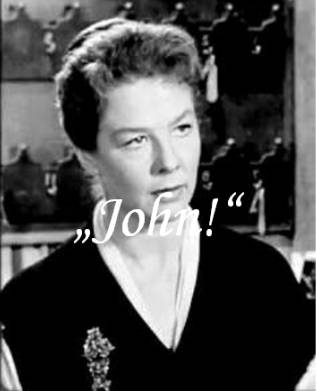
Wendy Hiller is also one of those actresses who can look totally plain in one scene and then lovely in the next one. When she sees Burt Lancaster you can watch how she suddenly lightens up despite trying to hide her feelings from the other guest. Her work with her dialogue is just wonderful when she meets him later secretly. She looks at him with so much love and passion despite keeping up a proper façade. The way she flirts with him and says about his proposal of marriage ‘Most women would feel rather odd about it especially when they hear it once rather late at night and the man has had a few drinks’ is a great moment.

But then his ex-wife, Rita Hayworth checks in at the hotel and wants him back, too. Pat seems to see her defeat already, telling John: ‘I always knew in my heart that you were still in love with her.’ Pat Cooper is a woman who doesn’t want to show her feelings and finds herself very quick in a difficult conflict: she has to be nice to her rival who is, after all, a guest in her own house and in whom she sees the pain and the sorrow over John while she also has to take care of the other problems in the house (especially concerning a delicate incident with Major Pollack) and during all this she also has to try to find a way how to organize her own feelings. When one of the guests tells her that she in an ‘alone-type’, Pat replies ‘I’m very glad you think so perhaps even gladder than you realize.’

Wendy Hiller plays Pat as the kind of woman everyone comes to with their problems because they know that if anyone is able to help them, it’s her– even John, who is after all her fiancé, later comes to her and wants to get some advice about his ex-wife. And Pat, being the woman she is, sees that he and his ex-wife are still meant for each other and helps them to see it, too – with the same efficiency she uses to run her house.

It’s a performance that shows how much can often be hidden underneath what may seem simple at first.

Number 48: Anne Revere as Mrs. Araminity Brown in "National Velvet" (Best Supporting Actress Ranking)

Anne Revere is the specialist when it comes to playing understanding and supportive mothers. There is something about her that makes her appear so wise and so warm at the same time and she always adds an enormous amount of grace and dignity to her roles. And while her other two nominated performances in The Song of Bernadette and Gentleman’s Agreement may have had more dramatic opportunities, her role as Elizabeth Taylor’s understanding mother showed her intelligence and her warmth at its most captivating.

Is there anyone who wouldn’t want Donald Crisp and Anne Revere as his/her parents? These two actors are able to basically steal the show from Elizabeth Taylor and her horse and add a completely new and unexpected dimension to the story.

Anne Revere played Mrs. Brown is a very quiet, no-nonsense and strong-faced woman. She doesn’t show a lot of emotion, but despite this, Anne Revere is still able to make her one of the most warm and caring women in the world. Somehow you don’t want to miss a word she’s saying, you don’t want to miss a second of her on-screen time. She guides all the other characters through their own storylines without ever making her own appearance too dominant. There is something transcendent about her as you can always sense the love behind her strong face.

The fact that Mrs. Brown has her own backstory – she became the first woman to swim the English channel – does not really matter in flow of the story apart from the importance of her prize money but you don’t have a hard time to believe that Mrs. Brown used to have her own life before she became a wife and mother.

Mrs. Brown also her own philosophy – she believes that there is a time for everything and that, once something is over, you should let it go. While this is all debatable, Anne Revere delivers her lines with so strength and decisiveness that you will believe every word she says. Especially in the scene in the attic, Anne Revere shines as one of the most admirable mother characters ever put on the screen.

All the honesty that Anne Revere put into this character also makes one of her final scenes so strong. When Velvet returns from the race and asks her mother if they were in the best in the world, Mrs. Brown answers with yes – and you just know that she would never say it if it wasn’t true.

Anne Revere certainly took what was probably supposed to be a plot device for a story around rising star Elizabeth Taylor and filled it with life and intelligence. Of course, the nature of the role did not give her any true challenged but she beautifully created her own challenges. Sometimes she may take her character’s strength a bit too far, though – her face sometimes appears to be almost unconcerned with the happenings around her and the constant wise words Mrs. Brown is asked to say by the screenplay make her sometimes appear like a fortune-cookie and you have to wonder if there is ever a moment when Mrs. Brown does not appear saint-like. Anne Revere’s maybe sometimes too dignified acting in some moments unfortunately underlines the problems of the character but overall, it’s still a beautiful and touching portrayal of one of the most admirable mothers ever put on the screen.

7/07/2011

Number 49: Fay Bainter as Aunt Belle Massey in "Jezebel" (Best Supporting Actress Ranking)

In 1938, Fay Bainter became the first person ever to be nominated for a supporting and a leading Oscar in the same year – in the leading category she was nominated for White Banners while her turn as Bette Davis’s aunt in Jezebel secured her a supporting nod. While Bette Davis herself won the leading statuette, Fay Bainter took home the supporting Oscar.

One has to view Jezebel very carefully to catch the performance by Fay Bainter. Not because her role is so small, it’s actually very big, but just because Bette Davis totally commands the screen and the whole movie is made as a vehicle for her. Unlike Gone with the Wind where all the characters are allowed to shine, Jezebel totally concentrates on the leading lady and barely lets the other actors have a chance to stept into the foreground. Because of that it makes me very happy that the Academy was able to see the second outstanding female performance of the movie: Fay Bainter as Julie’s worried and suffering, but loving aunt.

The character is introduced even before Bette Davis first enters the screen. At a party in Julie’s house, Aunt Belle has to explain her guests that Julie isn’t here yet. While she tries to be amused about the whole affair, she later tells one man with a quiet but upset voice ‘That child isn’t here yet. You’re her guardian, you have to speak to her! It’s outrages of her!’ In this first scene, Fay Bainter makes it clear that the character of Julie is Aunt Belle’s biggest and constant worry – her whole life circles around her niece, trying to make her behave in a more appropriate way since Julie is a very selfish woman who only wants things her way.

Basically, either being worried about Julie or happy about Julie or advising Julie is all that Aunt Belle aka Fay Bainter has to do in Jezebel (She says herself ‘I guess I love her most when she’s her meanest’) but she does it so hauntingly that it’s easy to see why the Academy honored her. Fay Bainter is a wonderful natural actress with a face made for close-ups (unfortunately, Bette Davis gets all those). She is also born for dramatic roles because her sad, worried face is simply unforgettable. When Julie disgraces herself at the Olympus Ball wearing a red dress, she watches her with that sad face and it’s clear how much she would like to help Julie but is not able to. And when Press leaves Julie, Aunt Belle tells her: ‘Julie, call him back! Don’t let him go! Julie, you’re a fool!’

It’s an essential supporting role as Fay Bainter never steps out of the shadows of Bette Davis but still finds enough opportunities to shine herself. Another wonderful moment is when she sees Press again and he brings his wife. While Bette Davis shows her shock more often, Fay Bainter has to hide her character’s feelings and says to Press’s wife with a shacking voice ‘My dear, Press’s wife would naturally be welcome here. But you are for your own sake.’

Bay Bainter never steals the movie but creates a very strong presence in Jezebel without ever really stepping out of the background which is truly a grand achievement.

Number 50: Goldie Hawn as Toni Simmons in "Cactus Flower" (Best Supporting Actress Ranking)

Goldie Hawn took home her only Oscar for her film debut as Toni Simmons, the ‘dumb blonde’ fiancé of Walther Matthau in the charming comedy Cactus Flower. Oh wait, actually, she is not truly his fiancé but his mistress because he is married. Oh wait, that’s not true – this is actually a lie he told her because he thinks that this way Toni will never want to get married herself. But then, one night, Toni can’t stand it anymore – the idea of not being able to have this man all for herself is too much for her and she decides to kill herself. What in reality should be the start to a very serious drama is here only the opening act for a romantic comedy of errors – who cares that she wanted to kill herself? Is she maybe mentally unstable? Who cares?

Okay, a movie like Cactus Flower should not be analyzed too deeply. Well, in the end, Julian thinks that marrying Toni would be the best solution, especially since he actually loves her by now – but, of course, new problems arise. Toni does not want to break up a family and wants to meet his wife. Enter Ingrid Bergman as Julian’s lonely secretary…

Okay, I think this should be enough plot details for now. As you can see, the movie has a lot of possibilities for entertainment and it’s also clear that Goldie Hawn’s role is much more a co-lead than a supporting performance. Anyway, what about her actual performance? Well, everyone who has ever seen a performance by her knows that she has a wonderful talent for comedy and this is also visible in every frame of Cactus Flower. Her Toni is certainly not dumb, only a little naïve and maybe even too good for this world – she would never believe that Julian would actually lie to her, she believes in honesty and loyalty. Goldie Hawn thankfully never exaggerated any of her acting to get some laughs – instead, she is almost subtle and very quiet in her part, staying true to the character by presenting her as an unwilling victim of lying and cheating. She focuses on Toni’s desire to make everything right and that way constantly unknowingly only making more trouble for Julian. In some ways, she seems to be a plot device that allows Walther Matthau to go from one new desperate situation to the next but Goldie Hawn knows how to avoid being pushed in the background.

It’s a very natural performance without any ‘big scenes’ but she flows beautifully along with the main storyline. Her big eyes and her short hair help her to make a lasting impression and it’s especially impressive that Goldie Hawn even manages to hold her own against an actress like Ingrid Bergman – she actually upstages her whenever they are together. When Toni finally learns the truth and small tears come out of her big eyes, it’s an unexpected and very heartbreaking moment.

It would be very easy for the audience to laugh about Toni because she is so clueless but you never do that because Goldie makes such a sweet-hearted person that can’t help but love her. Overall, it’s a funny, totally charming and believable performance.

Number 51: Olympia Dukakis as Rose Castorini in "Moonstruck" (Best Supporting Actress Ranking)

Olympia Dukakis took home an expected Oscar for her work as Rose Castorini, the suffering wife of a wandering husband and the supportive mother of a confused daughter in the romantic comedy Moonstruck.

Suffering wife AND supportive mother? OSCAR!!! Yes, there is no denying that this role is practically an engraved invitation to an Academy Award but if Olympia Dukakis took a challenging role and delivered – then why not?

Mostly, Moonstruck is about Cher and how her character has to decide between two brothers but Olympia Dukakis is easily the most valuable player in the ensemble – she’s the story’s emotional heart and creates a multidimensional, touching character. She brings a beautiful quiet dignity to her part, especially when she gives her sad, silent sigh. Her strongest scenes are in the restaurant when she meets another man and later when she tells this man in front of her house ‘I can’ ask you in because I’m married. Because I know who I am.’

Olympia Dukakis also has strong chemistry with Cher even though both actresses mostly follow their own story-lines. While Cher delivers the laughs and the romance, Olympia Dukakis presents the other side of love – a love that needs fighting, a love that may be lost already. There is nothing new and exciting about her relationship with her husband who fears that his life may be over already and got a mistress to cover these worries. Olympia Dukakis’s strongest scene is at the end, when she finally confronts him and tells him ‘I want you to stop seeing her’. Her tears, her assurance that she loves him and that his life is worth something, her ability to support her husband even at a moment like this – it’s all done magnificently.

Just like Rose is the centre of her family, Olympia Dukakis somehow became the centre of Moonstruck with her wonderful ability to combine comedy and drama and her strong screen presence.

Number 52: Kim Basinger as Lynn Bracket in "L.A., Confidential" (Best Supporting Actress Ranking)

Usually considered a rather poor choice for the win, Kim Basinger has always been a winner that I would not put in the Top 10 but that I still appreciate a lot nonetheless.

In L.A., Confidential, Kim Basinger played Lynn Bracket, a high-class call-girl with the obligatory heart of gold. In this part, she is almost the only female character in this man-driven story and the sexual tension and emotional sensitivity she brings to her role are a welcome change from other scenes of violence and murder. Most of all, Kim Basinger profits a lot from fitting so beautifully into the time and place the story is set – her unique beauty and her intriguing voice seem to come right out of the 40s.

Kim Basinger is a limited actress, I don’t want to deny that. But sometimes, these limits work perfectly in a certain part – like Lynn Bracket. The fact that she isn’t the most expressive or dynamic actress only helped to increase the mystery that surrounds this character. Right from her first scene at the shop when she wishes Russell Crowe a Merry Christmas and later tells him with a certain sarcasm ‘It’s nice to know you care’, she establishes a captivating presence that not only the men in the movie but also the audience feels drawn to.

Kim Basinger loses a bit of those effects when she becomes a more traditional character, basically a loyal girlfriend, but she scores high points during all the interrogation scenes opposite Russell Crowe or Guy Pierce – her way of flirting, of tempting these men is fascinating to watch and especially her chemistry with Russell Crowe provides some of the movie’s best scenes. Her sudden surprise when this man compliments her and she begins to see that there may be more to him than initially visible is done very beautifully.

Lynn Bracket is a fame fatale, a cold blond and a good-hearted woman – and Kim Basinger caught all these aspects in her performance while carefully staying in her own comfort-zone. It’s no tour-de-force but still a memorable and beautiful piece of work.

Number 53: Dorothy Malone as Marylee Hadley in "Written on the Wind" (Best Supporting Actress Ranking)

Is it trash? Or is it art? Written on the Wind seems to escape every bit of logic and analyzing by presenting itself as something so one-of-a-kind in every aspect that it becomes almost impossible to judge it compared to ‘normal’ movies or performances.

The most celebrated aspect of this movie is easily Dorothy Malone’s Oscar-winning turn as the nymphomaniac Mary-Lee, daughter of a rich father who sleeps her way around as a way to compensate Rock Hudson’s sexual disinterest in her. I used to have this performance a little lower in my ranking but I decided to put her up some spots even though I am still not entirely sure what to think of her. Some people call this one of the greatest performances of all time – I certainly would not go so far but the thing is that in the context of Written on the Wind, Dorothy Malone is, indeed, perfect. This movie demands this kind of performance, no doubt about that. There are some kind of performances that can only work in the movie they are set in – Gloria Swanson is outstanding in Sunset Boulevard but put her performance in a movie like On the Waterfront and you will have to wonder what the hell is going on. But even though – the type of movie still does not make Dorothy Malone’s performance seem completely flawless because even in the theatrical and melodramatic world of Written on the Wind, Dorothy Malone’s over-the-top acting makes me wince or laugh more than once.

It’s clear that Dorothy Malone and Robert Stack as her alcoholic brother are a true dream-team in Written on the Wind – they perfectly understand their material while Rock Hudson and Lauren Bacall deliver flat and uninteresting performances that would destroy the entire movie if the two supporting players wouldn’t constantly bring Written on the Wind back on track.

Basically, Dorothy Malone’s acting is this typical melodramatic acting from the 50s – like Susan Hayward, she constantly moves her body, constantly moves her head up or down, emphasizes every human emotions to the maximum. Dorothy Malone is not there to be realistic but become a vessel for Douglas Sirk’s sexual visions – and she clearly succeeds here. The porn-music that plays every time her character appears is maybe a bit too much, but hey…

So, Dorothy Malone has a juice, scene-stealing part, lots of screen-time and even a showy dramatic scene in the end – basically everything you need but, as I said, her acting style, even though meant for her movie, is not entirely for me. Her famous ‘mambo of death’, her confrontation with her brother when she tells him about a possible affair between his wife and his best friend or simply her delivery of a line like ‘Remind me to send you some of my towels. I believe you’re still wet behind the ears’ are so deliciously over-the-top that Dorothy Malone basically took the road to ‘bad’ but went so far that she came back to ‘brilliant’ – if ever a performance deserved the credit ‘so bad it’s good’, it’s probably this one. And in this case, I mean it as a compliment.

But other scenes, like the face she makes when her brother gets wounded after a fight with Mitch, the scene at the lake or her final scene in the court-room lack that camp-style that usually surrounds her work and therefore leave her totally on her own – and here she sometimes misses the ability to go from bad back to good.

So, it’s a performance that is impossibly hard to judge since it combines excellence with mediocrity like no other in this category but in the end, I can’t help but love her for what she doing here.

Number 54: Shelley Winters as Mrs. Petronella Van Daan in "The Diary of Anne Frank" (Best Supporting Actress Ranking)

I used to give this performance a better spot in my ranking and I also like it when the Academy recognizes un-showy performances that don’t seem tailor-made to win awards – but at the same time I just don’t like it too much when I have to ‘look for an Oscar-winning performance’, meaning that I would probably never even notice Shelley Winters in The Diary of Anne Frank if she had not won an Oscar for it. So, she’s maybe stuck with a very thin part that pales compared to almost every other one in the movie but Shelley Winters still made a large impression in this talented ensemble.

She played Mrs. Van Daan, the mother of Peter and one of the Jews hiding from the Nazis. Compared to the almost saint-like, perfect parents of Anne (played by Joseph Schildkraut and Gusti Huber who both should have been the nominees for this movie), the parents of Peter are more ‘realistic’ – they fight, they argue, they aren’t easy to be around with constantly. And this is also the aspect from which the movie gains a lot of its power – it shows how difficult it is for all these people to spend day after day after day locked together. More than anything, The Diary of Anne Frank shows the clash of different characters in an extreme situation. All this would make it very easy for the audience to dislike the Van Daans but Shelley Winters was able to combine the annoying aspects of her role with two others that are always sure to get the sympathy of the audience – the suffering wife and mother. It’s clear that she worries about her son just as much as Mrs. Frank worries for her daughters only Mrs. Van Daan also has her selfish husband, who often treats her like dirt, to care of. It’s mostly these scenes that show Shelley Winters handle Mrs. Van Daan’s life with her husband that are her biggest success – she is immensely moving when her husband wants to sell her precious coat to get some cigarettes for himself or when she has to defend herself in front of Mrs. Frank that she always gives her husband a little more to eat than everyone else. And this also lead to her best scene when Mr. Van Daan is caught stealing food in the middle of the night and Mrs. Frank wants to throw him out – Shelley Winter’s plead to let them stay is very moving and probably one of the most powerful moments of the movie.

Overall, Shelley Winters’s character is not only the opposite of Mrs. Frank but she also uses the opposite acting style than Gusti Huber – while Gusti Huber is mostly very subtle and not showing the worries that torture her character, Shelley Winters always shows the fears of Mrs. Van Daan. This way, she gets some very effective close-up that show her fear of death, of the Nazis, of being finally caught.

Among the ensemble of The Diary of Anne Frank, Shelley Winters does not really stand out but she is a powerful part of it.

7/06/2011

Number 55: Alice Brady as Mrs. Molly O’Leary in "In Old Chicago" (Best Supporting Actress Ranking)

After having lost the first Supporting Actress Oscar ever given to Gale Sondergaard, Alice Brady was back the next year and won for her portrayal of Mrs. O’Leary, the woman whose cow caused the big fire of Chicago. While My Man Godfrey the year before showed us Alice Brady’s wonderful talents for comedy, In Old Chicago allowed her to display a very captivating combination of comedy and drama.

Particularly right at the beginning when her husband dies during their journey to Chicago. Alice Brady is very moving at the funeral, when she tells her husband ‘Goodbye, Pat. Someday I’ll be sending the priest. To speak the proper words.’ Mrs. O’Leary now has to take care of her three sons by herself and soon she is the best wash-woman in Chicago.

Right in these early scenes, Alice Brady finds the foundation for the whole character of Mrs. O’Leary – she is a no-nonsense woman (whose most famous remark is a disapproving ‘Mmh’) who seems to be stern and tough but clearly loves her children and has a good sense of humor when she finds the situation fit for it. All this makes Alice Brady instantly loveable and she takes a simple part in what is basically an early version of those disaster movies from the 70s and creates a very strong, impressive and dominating character. She runs the gamut of emotions with a lot of poise and ease – she can make you laugh by drinking a large glass of beer just as easily as she can break your heart when she tries to escape the fire and loses the picture of her dead husband. Her voice can be as high as that of Butterfly McQueen in Gone with the Wind and as deep as that of the ents in The Lord of the Rings – and she uses both registers with great effect.

She also has a great chemistry with all the actors playing her sons, making the O’Learys a believable family (as Mrs. O’Leary puts it ‘The O’Learys against the world!’). This is neither a very complex character nor a deep characterization but Alice Brady still constructed a very original and charming character in which she is able to take everything that could make Mrs. O’Leary an unlikable person (like her stubbornness) and uses it for the opposite. She is a breath of fresh air in In Old Chicago and constantly able to put a lot comedy into her work.

Her later dramatic work during the Great Fire is also very impressive but unfortunately she is also given what must be one of the worst moments in any movie ever nominated for Best Picture – the final monologue in which Mrs. O’Leary talks about how her family will go on after she basically burned down the entire city. It’s a scene that is almost shocking in its weirdness and Alice Brady also visible struggled to get though it.

But this final moment is not enough to destroy what is an overall great and captivating performance!

Number 56: Mary Streenburghen as Lynda Dummar in "Melvin and Howard" (Best Supporting Actress Ranking)

The fact that Mary Steenburghen is an Oscar-winner seems to be rather forgotten today but in 1980, she swept the Supporting Actress awards for her performance as Lynda Dummar, the charming, quirky and a bit odd wife of Melvin, an eternal loser who constantly lets every bit of money he gets slip through his fingers.

Melvin and Howard is a very interesting but also strange movie – it’s the kind of movie that seems to have no real point and leaves the viewer with more questions than answers but it also provides some nice entertainment and some very unique characters. One of them is Lynda – she sometimes seems to be a bit slow but she is not stupid, maybe a bit naïve but at the same time she clearly knows what she wants. She doesn’t possess a true heart of gold – maybe silver because she is a very honest, open and good-hearted person but she will not tolerate any kind of behavior she can’t accept.

Mary Steenburghen is an interesting case for me. She is very lively and charming in Melvin and Howard and occasionally a true comedic gem but she also feels very static, lifeless and inconsistent at others. The problem is that Melvin and Howard, even though it tells a chronological story, feels very ‘jumpy’ without any real plot or character development and Mary Steenburghen seems to be a bit lost sometimes. Melvin and Howard is the kind of movie in which a lot happens while you feel that nothing happens at all – and this is the case with Mary Steenburghen’s performance, too.

It would be best to say this – when the script denies her any possibilities, Mary Steenburghen is still interesting to watch as the constructs the character of Lynda. When the script offers her any possibilities, she is golden. Her scenes in the strip clubs, where she works because she loves to dance, are hilarious and, of course, who can forget her most famous moments when she does a tap dance at a game show in TV? Her dance, her joy when she wins, her jumping around and screaming is simply unforgettable.

These comedic scenes are mixed with various dramatic moments like losing the custody of her child or leaving Melvin (for what feels like the 1000th times) after he again spent all their money on things they don’t need. Her little conversation with him before she leaves in which she tells him of her dreams of being a French interpreter is almost heartbreaking.

It’s a very original performance and if Mary Steenburghen had been given a stronger character in a stronger movie, she might really have been outstanding. So, she had to settle for a little less but still gives a great, memorable performance.